
Cristian Măcelaru featured in Cincinnati Enquirer Article
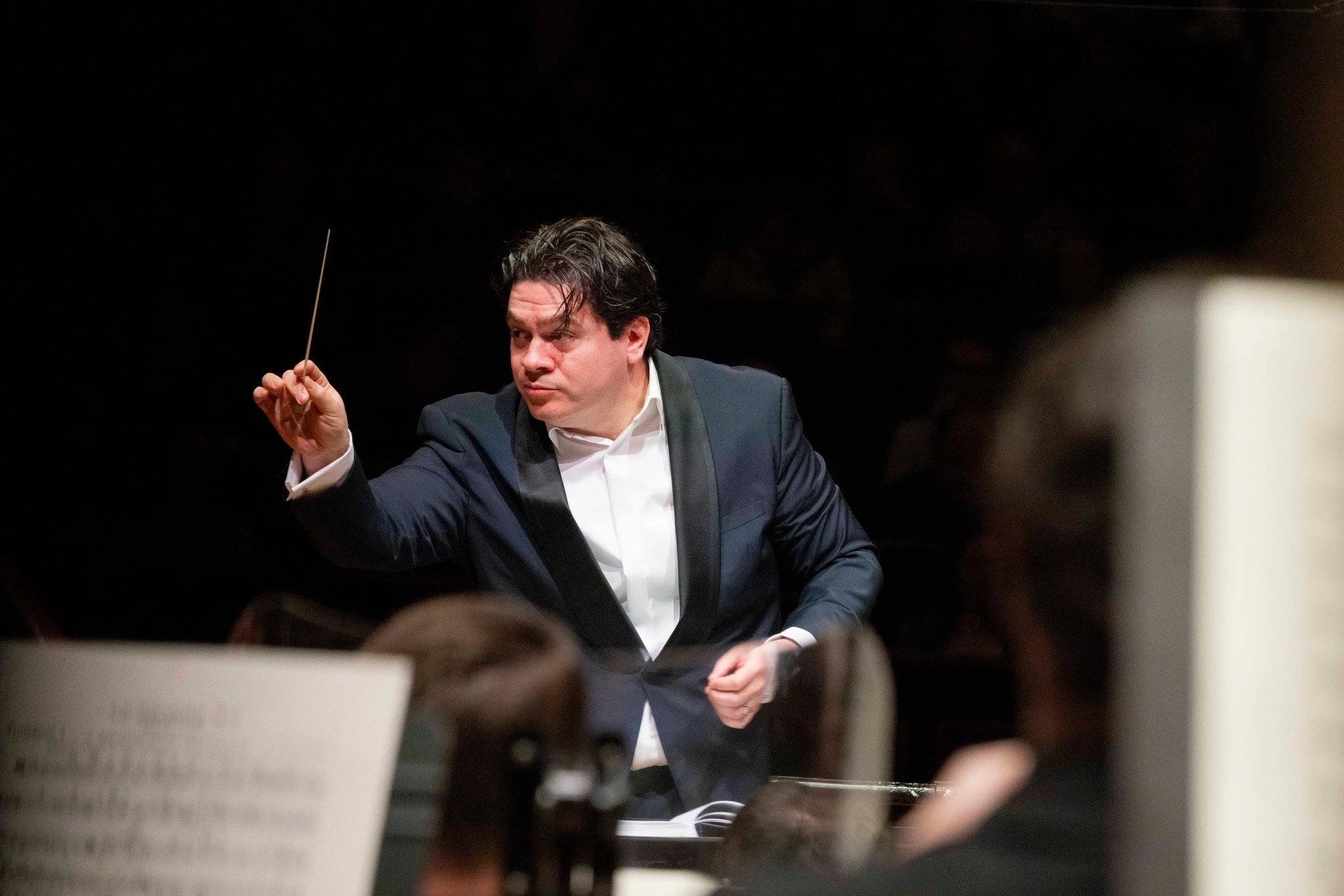
Photo Credit: Cincinnati Symphony Orchestra
From being 'that weird kid in college' to conducting the Cincinnati Symphony Orchestra
David Lyman
Cincinnati Enquirer
February 6, 2025
Cristian Macelaru is back. But just for the weekend.
For many Cincinnatians, his is not a familiar name. Not yet, at least. That is about to change. In April, Macelaru (mah-che-LAH-roo) was introduced as the 14th music director of the Cincinnati Symphony Orchestra, stepping into the position held for 11 years by Louis Langree.
At the moment, Macelaru is the “music director designate.” He doesn’t move into the position full-time until the beginning of the orchestra’s 2025-2026 season.
But he will be in Cincinnati to conduct a pair of CSO concerts Feb. 8-9 at Music Hall.
Think of these concerts as a preview of things to come.
As with every new music director, Macelaru will definitely change the orchestra. Precisely how is hard to know. It won’t happen overnight, mind you. But if he is at all like his predecessors, he is likely to be an integral piece of Cincinnati’s cultural landscape for a decade or more.
Macelaru is something of a musical polymath. He is fascinated by an extraordinarily wide range of music. He counts trumpet player and composer Wynton Marsalis among his best friends, for instance. And in this weekend’s performances, he was determined to lead the orchestra through pieces that are familiar – Dvorak’s “New World Symphony” and Chausson's “Poeme” – and some that are much less so: Marsalis’ "Southwestern Shakedown” from “Blues Symphony” and Florence Price’s “Violin Concerto No. 2.”
Violinist Randall Goosby, the Cincinnati Symphony's 2025 MAC Music Innovator, will join the orchestra and music director-designate Cristian Macelaru for a pair of concerts on … Show more
Jeremy Mitchell/Provided by Cincinnati Symphony Orchestra
Joining Macelaru will be Randall Goosby, the CSO's 2025 MAC Music Innovator and up-and-coming violinist who has taken the musical world by storm in recent years.
“Cristi and I have never actually met,” said Goosby, using Macelaru's nickname. “But I have watched many of his videos and – I don’t know if I can explain it, but I feel like we have some sort of connection. Maybe it’s because he is fairly young. (Macelaru is 44.) Or maybe it’s because he has this magnetic personality. I feel his enthusiasm comes across even in videos. I can’t wait to work with him.”
If you’ve read even a little about Macelaru’s background, none of this is unexpected. He took a very different route to conducting than most of his contemporaries. He didn’t attend any of the A-list music conservatories. He got a bachelor’s degree at the University of Miami, followed by graduate study at Rice University. They are fine schools, mind you. But they don’t carry the same prestige as Juilliard. Or the Boston Conservatory. Or, for that matter, the University of Cincinnati’s College-Conservatory of Music.
Macelaru wasn’t snubbing those more famous music schools. Rather, it was that, as the youngest of 10 children growing up in Romania, he simply couldn’t afford them. Like many students, he went where he could get the most economic support.
But in many ways, the decision helped shape Macelaru’s musical philosophy. He grew up in the “real” world as opposed to in the bubble of a conservatory education.
Growing up in revolutionary-era Romania – the country threw off its Communist government when he was 10 – he was intrigued by all things American. Through a chance encounter with a U.S. couple adopting a Romanian child, the 16-year-old Macelaru got a full scholarship to the Interlochen Arts Academy in Michigan.
From that moment on, he eagerly threw himself into the thick of American culture.
As he is fond of saying, “I am Romanian-born. But I am an American conductor. I’ve lived in America for 23 years. My kids were born in the U.S. My wife is American.”
And, though he doesn’t mention it here, he has been an American citizen since 2019.
“One of the things that attracted me to the CSO in the first place was that the orchestra has an equal footing in symphonic work, opera, pops and ballet. And they play so much choral music, too,” he said. Remember, the CSO is the orchestra for Cincinnati Opera, Cincinnati Ballet, the May Festival and, with a change of jackets, becomes the Cincinnati Pops. “The diversity and demands of a repertory like that is really healthy for an orchestra.”
It's a musical philosophy that Macelaru adores. The first time he conducted in Cincinnati, in 2015, it wasn’t for a CSO performance. Rather, it was for a Cincinnati Opera production of “Il Trovatore.”
“That’s how I grew up – I’ve always said ‘yes',” he said. “I was that weird kid in college. Who needs to play a recital? I want to play it all. It doesn’t matter what musical genre it is.”
That’s one of the reasons he intends to keep a busy touring schedule even after he becomes the CSO’s music director. It’s exhausting, he said. But it’s necessary if he is to do justice to the CSO.
Cristian Macelaru will replace Louis Langree at the Cincinnati Symphony Orchestra.
Ben Knabe/Provided by Cincinnati Symphony Orchestra
“The truth is, it’s really not easy on my body and me to be doing all these different orchestras.” Immediately after he conducts here, he sets off for gigs in Baltimore, Paris and Stockholm followed by a whirlwind 17-day jaunt through Germany, where he will lead five orchestras, in Cologne, Berlin, Munich, Bielefeld and Friedrichshafen.
On the one hand, it sounds glamorous. But in many ways, it’s like any work trip.
“I was in Vienna for a week, and how much of Vienna did I have a chance to see? Nothing. But you see, conducting is a two-way street. I am just as transformed by the orchestras I conduct as they are by me,” Macelaru said, speaking from his home in Paris. “If I went nowhere else, I would not be doing the Cincinnati Symphony a favor. As a conductor, I need to hear other orchestras. I can’t stop learning just because I have a great orchestra like the Cincinnati Symphony. There is always something to learn. Not just with the musicians, but with the audience, too.”
Read the original article here